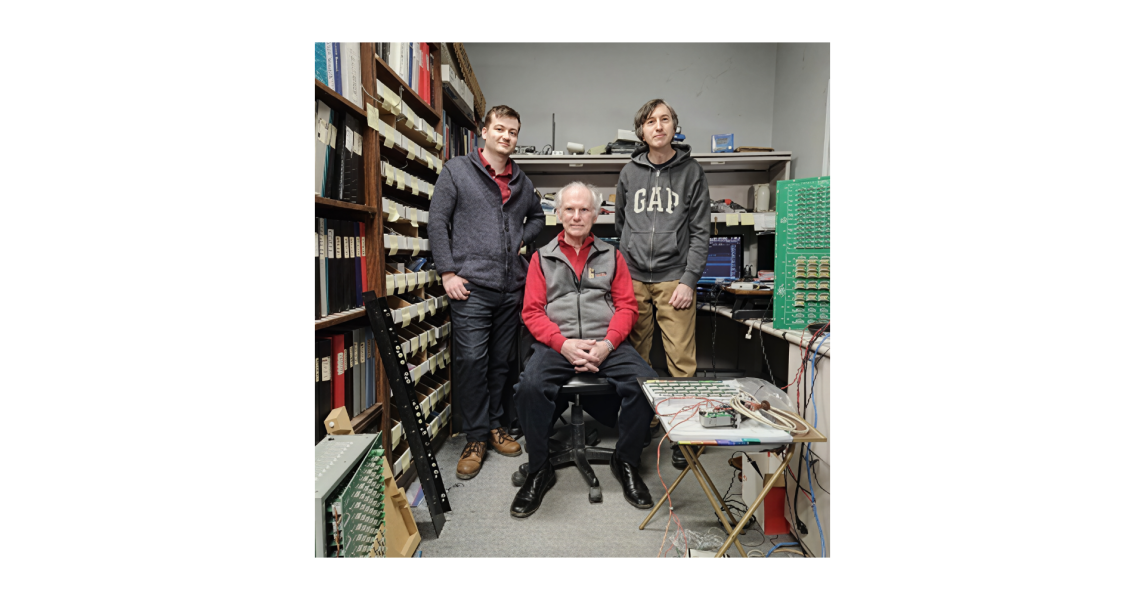
Henry Wemekamp will be the first to tell you he didn’t expect to be in the organ business for 50 years. But then again, he'll also tell you his company was the first in the world to put a microprocessor in a pipe organ. Clearly, Wemekamp has a habit of doing things nobody expected. Fifty years later, it turns out that's exactly what makes him worth paying attention to.
This year marks the 50th anniversary of Artisan Classic Organ, Inc. The Markham-based business is a world leader in designing and building electronic components for classical organs. But back in 1976, working in the world of classical organs wasn’t on his horizon.
Wemekamp had just graduated from Queen’s University with a degree in electrical engineering. At the time, many of his peers were going to work for defence companies, but Wemekamp said it wasn’t an area he was interested in. Thankfully fate had a plan for his talents.
Wemekamp's brother-in-law was an organist who wanted an electronic organ he could practice with at home. They found a used one, which Wemekamp quickly rebuilt—tubes, transistors, and all. That first experience with organs had him hooked on the instrument and its music, but it would be a roadtrip from Kingston to Toronto that would set him on his 50-year journey.
“I walked into a piano and organ store on Yonge Street and talked to the owner. He told me that the Conn Organ Company was looking for a technician and installer,” Wemekamp recalled. “I went over and they immediately offered me a job. That's what got me into the organ business.”
In 1976, Wemekamp had his “opus one” with the launch of The Classic Organ Company Ltd. His project was the rebuild of a church organ in Toronto. The company briefly merged with Artisan Organs Ltd., followed by a rebrand to Artisan Classic Organ Inc. The company’s headquarters today on John Street is just a short drive from its first shop on Don Park Road.
Today, Artisan's technology can be found in some of the most prestigious concert halls and churches in North America. Locally, their systems power the organs at Timothy Eaton Memorial Church and Metropolitan United in Toronto. South of the border, the list reads like a tour of America's great performance spaces — Boston Symphony Hall, Portland's Civic Auditorium, and Minneapolis Symphony Hall among them. From small two-manual organs in rural country churches to the towering instruments in New York City's cathedrals, Artisan's fingerprints are everywhere.
That kind of reach is no accident. Wemekamp has always thought of Artisan less as a music company and more as a technology company that happens to serve the organ industry.
"We bring technology to the music industry, whether that's sound creation or control systems for pipe organs," he said.
That philosophy is embodied in Maestro, the company's next-generation control system built on Linux, which allows for remote monitoring, maintenance, and even lets organists dial in to adjust their presets from anywhere in the world. With over 1,000 installations and counting, the rest of the industry, Wemekamp noted, is still catching up.
But 50 years in, the road ahead isn't without its bumps. With roughly 75% of Artisan's business coming from the US, the current tariff climate has created uncertainty among American customers.
"The impression is worse than the real thing, but it has hampered our business," Wemekamp said.
In response, the company is doubling down on the Canadian market and exploring new opportunities in West Africa, where demand for classical organ music is growing. And then there's the matter of succession planning.
“I need a new person to take over who has a new vision for the next 50 years,” Wemekamp said.
For a company that has spent 50 years doing things nobody expected, the next 50 should be no different.