The source for inspiration can come from virtually anywhere. It could be from a talk at an industry conference, a conversation with a client, or an idea that sparks on a walk through the Milne Conservation Area.
For Leigh Newman, the idea for his business was found in a single video on YouTube. Newman had spent years building a reputation in civil and general contracting the hard way—self-taught, working on high-rise retrofits, long-term care facilities, and Infrastructure Ontario projects. But it was a conversation seven years ago with one of his subcontractors that would change the course of his career.
“It was one of my concrete subs who showed me a YouTube video of a building being printed with a COBOD 3D printer,” Newman recalled. “Right away, I knew this was the future of construction.”
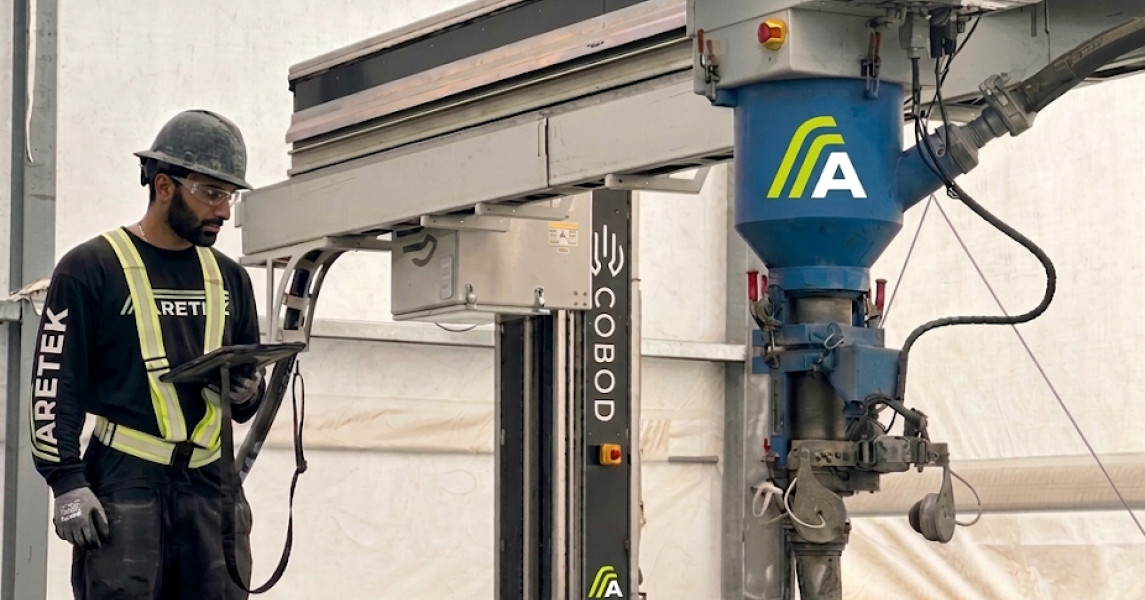
Inspired by the potential for 3D construction Printing (3DCP), Newman founded Printerra (now known as Aretek) in 2022 and purchased the company’s first COBOD printer in 2023. But like any business pushing into the bleeding edge of technology, the reality didn’t match their expectations.
“We were given all these promises, but after a week of training, we barely had our printer set up. But we knew we were onto something,” he said.
Even though other industries like automotive and aerospace have adopted 3D printing, Newman said the construction industry is often the last industry to adopt new technologies and innovations.
“Construction is still brick and mortar, 100 years later. They're rigid to change,” Newman said.
Aretek is addressing that resistance head-on by building a complete additive construction solution that covers everything from engineering and design to printer procurement and materials and hands-on training.
Aretek's proprietary 3DCP Engineered Wall System is the backbone of its platform. Unlike traditional construction, where walls are built by hand, Aretek's system uses a computer-guided printer that lays down concrete layer by layer with precision. The company works with both 1K systems, which use a pre-blended dry mix that simply requires water, and 2K systems, which batch custom concrete recipes on site to meet specific project needs.
Because Aretek is technology-agnostic and distributes multiple printer types, it can match the right equipment and materials to any project. What makes their approach unique is not only the technology, it’s the approach to changing the industry. Aretek has spent three years developing and testing a wall system that can get approved for use in Canada.
“There are no standards for 3D printed walls anywhere. If you go to the building department, there's no dropdown box that says 3D printing, so we compared our system to masonry construction, because we're building layer by layer, block by block,” Newman said.
That approach earned Aretek Canada's first alternative solution permit for a structural 3D-printed building, currently under way in Windsor. The project is the proof of concept that Aretek has been building toward. At just under 14,000 square feet and three stories tall, it will be the largest structurally 3D-printed net-zero building in North America.
Much of the research that made the project possible was done here in Markham. Aretek has an 8,000 square foot research and training facility at York University's Keele campus, and Newman said the city has been a natural fit for what they're building.
"There's a lot of tech in Markham, but we're one of the few construction or prop tech companies," Newman said. "Markham and York University have really been a strong foundation for us.”
Aretek is currently working on getting approvals for projects in Toronto and has a proposal in front of the Mississaugas of the Credit for an indigenous housing development. The rebrand from Printerra to Aretek reflects where the company is headed—beyond printing, toward becoming the full-stack platform and driving the regulatory pathway for additive construction adoption in Canada and beyond.
"We don't want to print every wall in the world. We want to provide the platform for people to build for themselves, and then take that model and spread it globally,” he said.