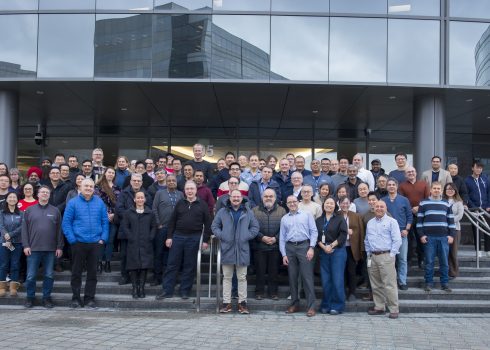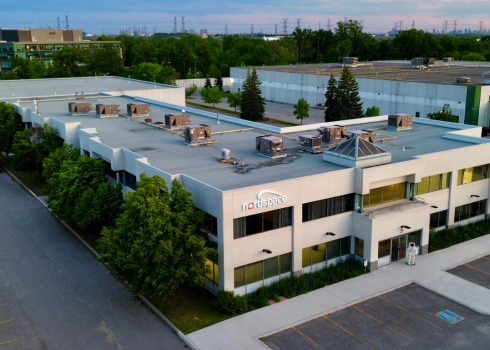
For over 50 years, CGI’s team of consultants and professionals has designed, developed, and implemented scalable and sustainable IT and business solutions for clients around the world. Founded in 1976 in Montreal, Que., CGI has grown from two employees to 94,000 with expertise in over 20 industries across 400 offices, including its Markham office on Commerce Valley Drive.
CGI’s Markham office is a hub for the company’s AI and robotics expertise. It also serves as a key onboarding location for many new CGI employees, said Gaurav Juneja, Senior Vice-President and Business Unit Leader for commercial, utilities, and public services.
“I started right here in this office,” he recalled. “It continues to be where many of the new people joining CGI in the GTA start their journeys.”
Gaurav joined CGI in 2017 as a consulting services director. Today, he leads a team supporting CGI’s manufacturing, retail, distribution, public sector, municipalities, healthcare, and government clients. Working closely with clients gives Gaurav new insights into the problems they are working to solve.
“When we work with municipalities, it's quite meaningful to see how the different government agencies come together to solve complex problems,” he said.
With such a broad range of industries and clients, CGI has built a global team of experts to address virtually any challenge.
“At CGI, no two hours of a day are the same because our clients are constantly facing new opportunities and challenges,” Gaurav said. “Working across industries, from municipalities and healthcare to utilities and manufacturing, gives us a unique perspective on how technology is transforming organizations. Whether it's AI, cloud, enterprise platforms, or connected infrastructure, our focus is on helping clients not only solve today's business problems, but also prepare for what's next.”
One emerging area that Gaurav said CGI is helping more clients with is “physical meets digital” — the use of data from sensors and other sources to drive decisions in virtually every industry.
“In many instances, the last mile is the same. It’s physical,” he said. “It could be data from a utility tower, a transformer, or the meter on your home. The question is, how do we use technology to make the physical world more effective?”
Internet of Things (IoT) devices and other sensors are estimated to generate billions of gigabytes of data every day. Finding insights into that data can be challenging, but Gaurav said the rapid development of artificial intelligence (AI) tools is already making a difference in how CGI supports its clients.
“The rise of AI is really helping us solve that physical-digital efficiency and effectiveness challenge. You used to need a human to tell what was going on with data. Now AI can do that, which means the effectiveness of the work has increased,” he said.
Gaurav gave infrastructure inspection as an example.
“CGI has tools that can tell whether a crack on a bridge is benign or whether it needs immediate attention. That assessment can come from pictures and videos collected by cameras and drones,” he said. “Before, you'd have to send a maintenance crew just to check whether it was real. Now technology can do that for you. That's a big thing.”
As advancements in AI, IoT, and other technologies create new opportunities, Gaurav said CGI is continuing to build its team to tackle the problems of tomorrow. The company recruits co-op students from universities across the GTA and has a strong new graduate development program. Gaurav added that there are many employees at CGI who began as co-op students and are senior leaders today.
“We have to be ready for whatever the future presents, and being ready means having a foundation and a culture in the organization that sparks change,” he said. “Nobody knows what 12 months from now will look like. But keep the foundation strong, and you can build your house however you want on top of it.”