Canadian innovation has played a key role in the development of artificial intelligence going all the way back to the work of Dr. Geoffrey Hinton at the University of Toronto in the late 70s. His pioneering research in deep learning laid the groundwork for the AI-powered tools that are changing the way we work and live.
It’s that same spirit of curiosity and outside-the-box thinking that Mark Sternberg, vice president of engineering at Qualcomm, said is driving AI innovations inside the company’s Markham offices. Curiosity, outside-the-box thinking, and some great croissants from Duo Pâtisserie & Café.
“They really get people going. Toronto Life ranked them as some of the best,” Sternberg said. “The team goes there all the time. Our butter content has probably gone way up.”
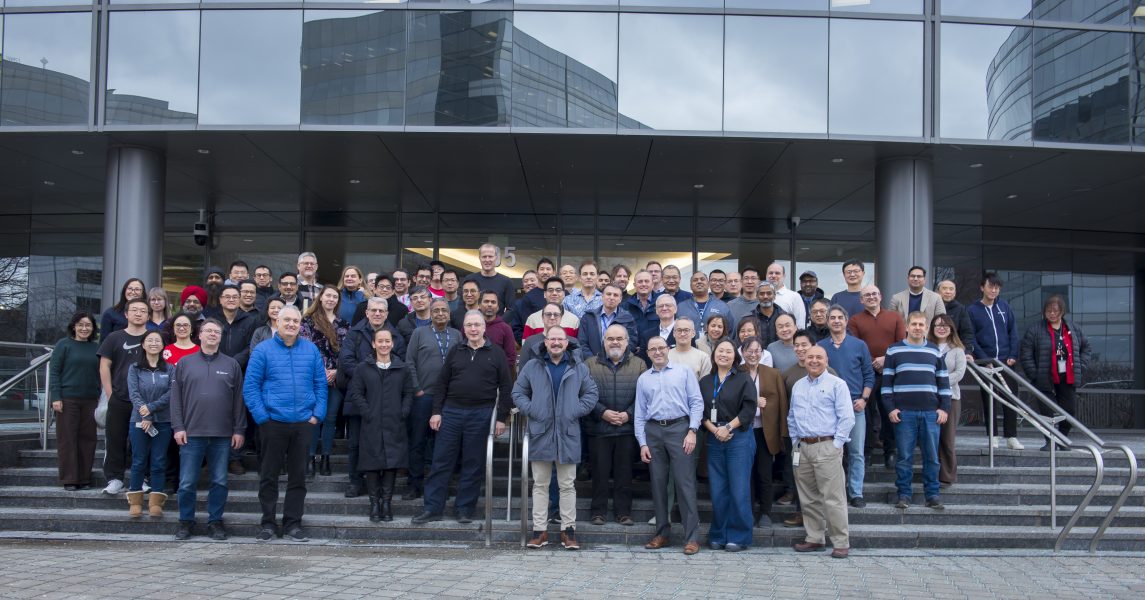
Sternberg has seen the Qualcomm Markham team grow since the company came to the area in 2009 when fellow Markham tech leader AMD sold its handheld graphics and multimedia technology to the San Diego-based tech giant.
Many of AMD’s employees, including Sternberg, moved to Qualcomm as part of the acquisition and continue to lead the company’s development of processors for everything from phones and wearables to vehicles and autonomous robots.
“There's nobody that does what Qualcomm does,” Sternberg said. “There isn't a device or sector that Qualcomm isn’t working in one degree or another.”
Working on automotive technology products was a natural choice for the Markham team. Sternberg said the team works very closely with automakers across Ontario and Detroit.
“Detroit is just down the street—so to speak—and today the auto team works globally with every automaker out there on leading-edge infotainment systems,” he added.
Qualcomm’s Markham office is also “just down the street” from where Dr. Hinton had his lab at UofT. It’s a proximal coincidence not lost on Sternberg.
“Almost 40% of people in this building are working on some sort of AI,” he said, “Whatever device you're using, we have some sort of AI component in it. That’s great because we're building that expertise in hardware, software, architecture, and algorithms. It's quite exciting.”
Qualcomm has been working on AI technology since 2018. The company’s focus is on edge AI—solutions that let devices use AI in low power, low connectivity situations like in remote areas or inside large industrial factories.
“It's not generative AI or agentic AI. It could be as simple as making your noise reduction more effective, image enhancement more accurate, or saving power on a device,” Sternberg said.
While AI traces its roots back to UofT, today you can find pioneering AI research being done at York University. Qualcomm recruits co-ops and employees from York and other local universities along with partnering with professors on research projects.
"We'd like to supercharge that in the future — it's about making sure that not just older engineers like myself are effective, but that we're teaching the next generation how to use the tools and become productive," he said.
As Canada continues to make AI development a priority, Sternberg sees a growing role for the Qualcomm team.
“We're quite excited about where Prime Minister Carney is taking Canada, and we're looking for opportunities to help with that growth,” he said. “I want to make sure that we can do what we can to leverage Canadian talent to make Qualcomm and Canada better.”