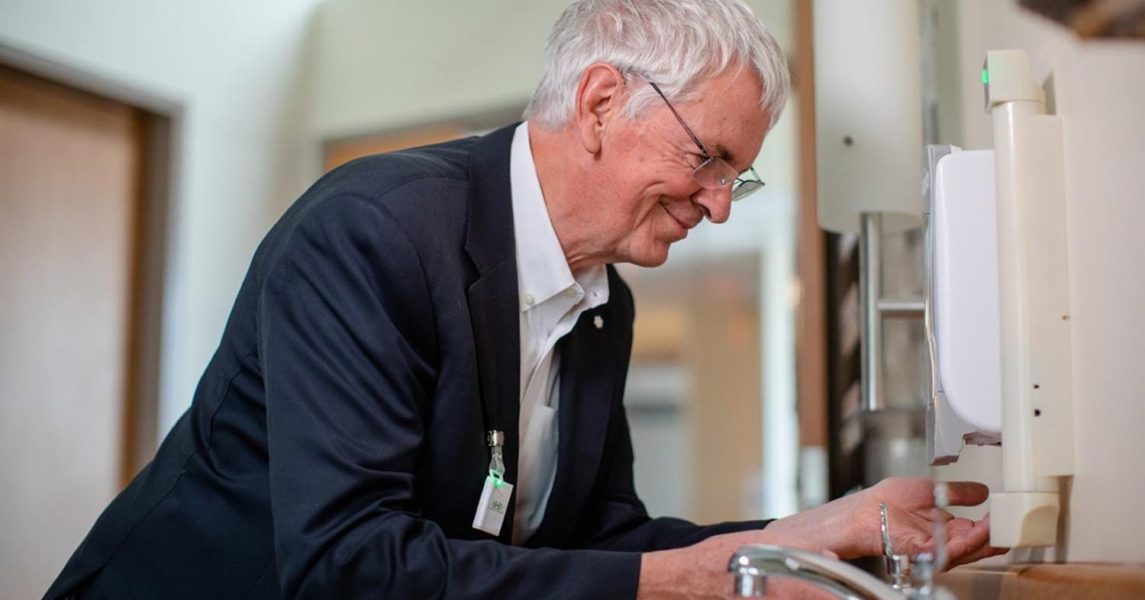
Each year, 220,000 patients in Canadian hospitals or long-term care facilities are diagnosed with a healthcare-associated infection (HAI). Most of these infections are transmitted from patient to patient through contact with the environment or with staff. As antibiotic resistance increases, reducing these infections is more crucial than ever. Implementing proper hand hygiene can significantly reduce these infections, leading to fewer people in hospital and more resources for hospitals to deliver better care.
But if we know hand hygiene is the solution, why is the rate of infection not reducing each year?
Dr. Geoff Fernie, Founder and CEO of Hygienic Echo, says the challenge is not a question of how hand hygiene is performed, rather it’s how often hand hygiene is required.
“Using an alcohol-based sanitizer for 15 to 20 seconds seems simple enough, but in practice, a nurse would have to perform hand hygiene nine times an hour. That’s almost 100 times in a typical shift. It’s a challenge to both remember to do it and to find the time,” Fernie says.
Fernie has researched this problem for over two decades, including his time as the Research Director of the Toronto Rehabilitation Institute at the University Health Network (UHN). His research led to the idea for the Buddy Badge, Hygienic Echo’s intelligent, wearable device that prompts hand hygiene only when necessary. The system even includes a reward component to encourage compliance across teams.
Fernie is quick to note that the system does not track healthcare workers. It knows where and when hand hygiene should be performed and discreetly reminds the wearer.
“We deliberately chose the philosophy of ‘buddy’. It's there to help you remember and encourage you when it's time to practice hand hygiene,” Fernie says. “The wearer makes that decision. They're professionals, but it helps take some of the mental load off and gives recognition that what they’re doing is important.”
Hygienic Echo’s solution is sophisticated technology, but its success is based on understanding the human factors behind the problem it is solving.
“We spend a lot of time trying to understand what the staff are trying to do so we can support them to do their work. We don't just dump a load of electronics and turn it on for them. We're part of the team providing support on infection prevention,” Fernie says.
While Hygienic Echo’s roots are in Toronto, the company is proud to call Markham home. In 2023, the company moved into ventureLAB to jump start its growth. It was at ventureLab where Fernie says they were able to see the full value chain of its solution. The work paid off with Hygienic Echo winning the $30,000 first prize at the 2023 HardTech Competition supported by ventureLab and York Region.
“Our ventureLAB mentor Ravi Gananathan saw our potential. We wanted to focus on hand
hygiene technology, but Ravi helped us see that we do much more than just hand hygiene. We are an infection prevention company that is poised to grow locally and expand globally,” Fernie says.
It wasn’t just the company that moved to Markham. Many of the leadership team, including Fernie and Chief Partnership Officer Catharine Hancharek also chose to make Markham their home.
“Everything about Markham is really compatible with our culture of kindness, care, and collaborations,” Hancharek says. “Markham is a city that is willing to do, not just talk. We love that culture of doing. We love the culture of people helping each other to succeed. We want to help Markham because the city cares and wants to do everything to help businesses grow.”
With Sunnybrook Health Sciences Centre, and Unity Health Toronto as our leading healthcare partners, Fernie says the future looks bright—and healthy.
“We are helping to reinforce a culture of infection prevention and we're leading the world in that area now,” he says. “Our focus is on Canada, but in time, we will be global.”