Global demand for electricity has reached record highs over the last decades. The reasons vary from an increased need for air conditioning driven by rising temperatures to the rapid construction of data centres for artificial intelligence platforms. Meeting that demand is pushing traditional and green energy production to its limits.
But what if there was a way to get more energy from our current infrastructure while reducing its carbon footprint? That’s the promise of direct current (DC) power distribution, an alternative that predates the alternating current (AC) power systems that we use today.
DC flows in a single, steady direction, but has historically been difficult to convert into higher or lower voltages. AC power switches directions back and forth, allowing it to be easily converted to different voltages, but significant power is lost as heat during that conversion process.
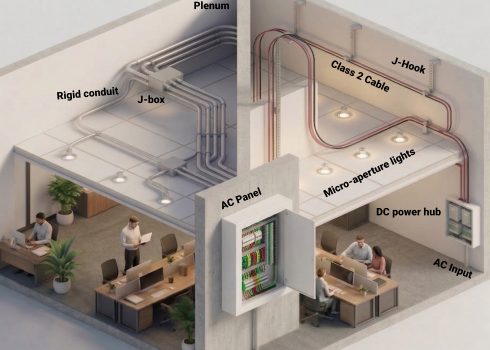
Thankfully, recent advancements in DC power are creating new opportunities to rethink how we can distribute power more efficiently. Leading that charge is Bolis Ibrahim, President of Markham-based Cence Power. The company has developed DC distribution systems that are bringing electrical infrastructure into the future, including for the growing demand for LED lighting.
“Our Class 2 low voltage system is primarily used for lighting, an industry that has a lot of activity in Markham and across the GTA. We’re surrounded by players in the construction value chain, from architects and engineers to lighting designers and electrical contractors,” Ibrahim says.
In addition to the low-voltage system, Cence Power is the first Canadian company to launch a Class 4 DC power distribution system. Known as fault-managed power, the system can deliver higher voltages over longer distances like AC power, but safer. Class 4 power systems are the first new class introduced since 1978, and Ibrahim has had a front row seat to updating the electrical code as a member of the Canada Standards Association working group.
Ibrahim says the Class 4 power system is perfect for telecom and data centre applications where power is in high demand. Fault-Managed power requires less copper than traditional AC power systems, reducing construction costs and carbon footprints. Fault-managed DC power systems can even detect faults that can cause shock and fire hazards and disable itself before an electrician or other technician is injured.
“In telecom, many systems use 48-volt DC power. We can deliver roughly ten times that voltage in a cable that is a tenth of the thickness,” he says. “We’re also making it safer for technicians to work, because many telecom workers are not trained to work with the dangerous voltages of AC power systems.”
Building the future of electrical distribution in Markham makes sense for Ibrahim and the Cence Power team. He says being surrounded by tech leaders like AMD and Qualcomm attracts world-class talent and businesses to the area, fueling the company’s product development efforts.
“Markham is a manufacturing hub for electronics. We have access to printed circuit board assembly houses, fast shipping on electronic components. We have same day pickup in a lot of cases because we’re just around the corner from many of our suppliers,” Ibrahim says. “We can go to ventureLAB to test something if we don't have a piece ofequipment available at our facility. Markham is just such a unique area.”
It’s not just the manufacturing and technology ecosystems that make Markham great for Ibrahim. He says whether it’s grabbing lunch in Downtown Markham with a partner or enjoying a night out in Markham Village, he says there is something for everyone.
“The community is very vibrant. It’s a rich, diverse community and a good representation of what Canada has to offer the world.”